HP LaserJet Printers - Toner Usage & the Impact on Print Cartridge Yield - HP laserjet p1102
HP LaserJet Printers - Toner Usage & the Impact on Print Cartridge Yield - HP laserjet p1102
Printing System Introduction
The design details of the print cartridge/s used in HP LaserJet printers
differs between printer models to reflect the different customer needs
being addressed by different printer models. For example, a LaserJet
monochrome printer can have a different cartridge design than an HP color
LaserJet printer. Color printing is more complex than monochrome printing
and the cartridges used in color printing can differ significantly between
different HP color printer models. These design differences are driven by
HP's goal of delivering the best value, printing experience and
outstanding print quality for a variety of customers who have different
printing needs.
HP designs its LaserJet printer systems to deliver outstanding value and
print quality over the life of the printer. In order to accomplish this,
the LaserJet printer system is made up of the printer itself and the HP
LaserJet print cartridge/s. These print cartridges (which are sometimes
called 'toner cartridges') contain far more than toner. These print
cartridges are complex multipart systems, one part of which is toner.
Print Cartridge Overview
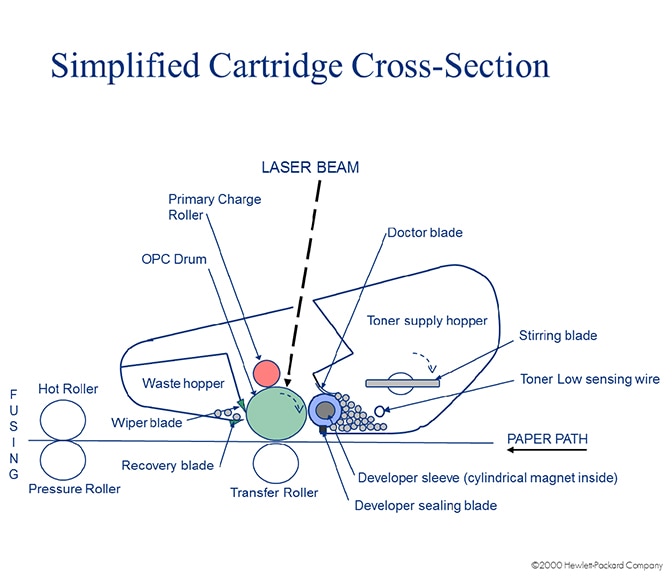
All LaserJet cartridges contain a number of mechanical parts in addition
to the toner. These components—such as developer, photo conductor
(PC) and cleaning blade—wear during the printing process as the
toner is used. While these components are designed to be durable,
different printing styles can cause different parts within the cartridge
to wear at different rates. For example, in some laser printers, the
printing of mostly low coverage pages might result in other cartridge
components wearing out before the toner is depleted. In another case,
printing mostly on narrow paper like envelopes can cause the PC to be the
first component to reach end of life. These worn components will
ultimately lead to print quality degradation just as toner depletion can
lead to print quality degradation.
In addition, the toner itself is a complex chemical formulation designed
specifically to work with the other printer system components to deliver
consistent high print quality. Because it is physically impossible to
extract all of the toner in a LaserJet print cartridge for printing
purposes, some residual toner will always remain in the cartridge, but
whether this toner is useable and the amount of this residual toner will
differ depending upon customer printing styles and cartridge design.
Because toner is subject to physical movement (stirring) during printing,
the toner can actually become 'worn' during the printing process to an
extent that it can become unusable. This wear can limit the ability of the
toner to develop the image correctly and cause print defects.
Continue printing with the current cartridge until redistributing the
toner no longer yields acceptable print quality. To redistribute the
toner, remove the toner cartridge from the printer and gently rock the
cartridge back and forth about its horizontal axis. For graphical
representation, see cartridge replacement instructions. Reinsert the toner
cartridge into the printer and close the cover.
Factors Affecting Print Cartridge Yield
Other factors can also impact print cartridge yield. For example:
-
Stop and start printing - Each time a print job is started there are several rotations of the printing system before and after printing is complete. These rotations cause wear to all components in the printing system, including the toner.
-
Printer power cycles – Turning the printer off will cause additional rotations when powered back on. In addition, most color laser printers will calibrate when the printer is turned on.
-
Calibrations on color printers – In order to maintain superior print quality, color printers require calibration. Every time a calibration is performed it results in component wear. Situations which trigger a calibration are: environment change, cartridge change, power cycle, and printing a certain number of pages.
-
Environmental issues at the customer site - HP designs its printing systems to provide quality and reliable printing over a wide range of environments, but some environments can cause the system to use more or less toner, impacting the yield. For example, very humid environments can cause print cartridge yields to decrease.
-
Alienation issues and alienation formulas - On color printers, there are special modes that disengage the color cartridges from the system when monochrome only documents are printed. This is called alienation. Depending on the frequency of monochrome and color documents being sent to the printer, the alienation system might not disengage the color cartridges in some instances. Customers value fast printing speeds so the alienation system is designed to strike a balance between printer speed - which is faster when cartridges are not alienating frequently - while minimizing the wear on the color cartridges. The frequency of alienation can impact the life of the color cartridges due to increased wear on the cartridges rather than use of toner.
-
Toner as cartridge lubricant - In the printing process, there are systems where a very small amount of toner is used for lubrication. Contact areas between cleaning blades on the PC and on the transfer systems require a small amount of toner to reduce friction and increase life. Use of this toner is taken into account when conducting ISO yield testing (stated differently, 'extra' toner has been included in the cartridge during manufacture to account for lubrication).
-
Under printing - To improve the "blackness" or overall PQ of some areas of a print, HP might use some colored toner along with black toner to generate certain black areas on the page. This is done to provide the highest print quality possible for the customer.
-
Manufacturing variances - As with all manufactured systems, there will be some variation in all of the parts of the printing system. Some of this variation can be accounted for with calibration of the printing system—so from time to time the HP printers will calibrate themselves. Other manufacturing variance cannot be accounted for with calibration and might impact the yield of the printing system. To ensure this variation is minimal, HP uses multiple printers and print cartridges when measuring yield. The ISO testing methods that HP uses require a minimum of 3 printers each using a minimum of 3 cartridges/cartridge sets.
-
Composite black - For black and white images and photos, a blend of colors called "composite black" might be used to achieve significantly better image quality and smoother gray tones than can be accomplished with black toner alone. For users who wish to print images using just black toner, many HP color printers offer customer configurable options enabling the customer to print using only black toner. For example, by selecting "print in grayscale" in the printer driver specifies printing using only black toner.
-
Duplex printing - in order to print on both sides of a page, the paper must travel a longer distance while the printed side of the page is reversed. This can cause more rotations and mechanical wear on the cartridge and lead to reduced cartridge life and page yield.
-
User Selections (Print Modes and Density Settings) - The user can also influence how much toner is used to print a photo or a document. There are two settings provided in the printer, one involves print modes and the other density setting. In general for print modes, draft modes will have lower print quality and use less toner than the default normal mode. The density setting can be adjusted from 1 to 5, with 3 the default. The lower the setting the lower the amount of toner used. There might also be device specific settings which are described in the applicable Product User Guide.
In HP LaserJet printer systems, all supplies are required to be installed
in the printer for the printer to function. This minimizes the risk of
paper or other media being wasted during the printing process.
Comparing HP Print Cartridge Yields
The ISO/IEC yield methodologies allow the customer to compare the declared
yield of cartridges from many different manufacturers. The printing style
of the customer (type of documents printed, number of color pages, size of
print jobs, image density, simplex v. duplex, etc.) will have a
substantial impact on the cartridge's actual page yield. Accordingly,
actual yield might vary considerably from the declared yield and HP cannot
guarantee that a customer will always achieve the declared page yield.
Many customers will find that their print cartridge provides more pages
than this declared yield and other customers will find that their printing
style results in the cartridge providing less pages. For more detail on
LaserJet page yields got
to: http://www8.hp.com/h71041/learn-about-supplies/us/en/toner.html
https://support.hp.com/

Comments
Post a Comment